
Blue Moon (2025)

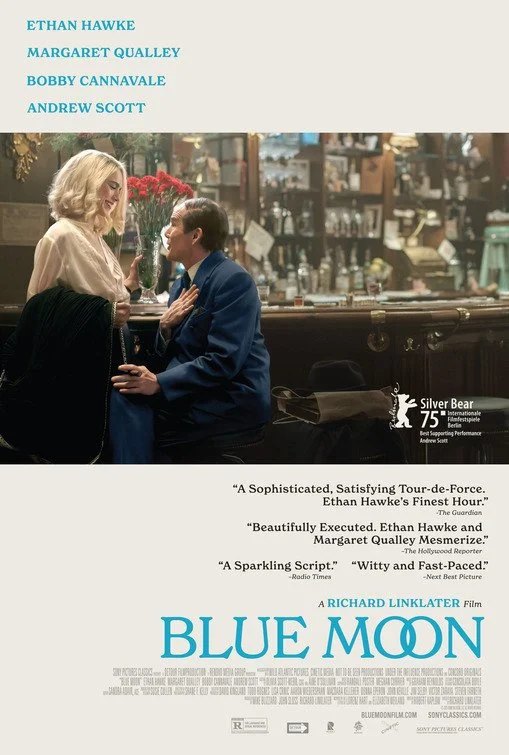
SHOULD I SEE IT?
YES
Ethan Hawke gives a career-defining performance as Lorenz Hart.
Writer/director Richard Linklater knows how to manage ensembles expertly well and Blue Moon is no exception.
There’s an intimacy to the film that is appealling and compelling, with the singular setting and close-knit, intimate cinematography.
NO
However, that singular staging can also work against a film that desperately needs more context to draw us into the world Hart (and Richard Rodgers) inhabit.
Dialogue-dense, the film can sometimes feel stuck and stagnant until a new cast member arrives and gives it a jolt of energy.
Feels like this could easily be a stage play, with the film proving too “talky” and slow for some viewers wanting more.
OUR REVIEW
In Blue Moon, Ethan Hawke and Richard Linklater reunite for a seventh time, with Linklater stripping his film down to a single room and a single night of storytelling - and Hawke delivering a performance unlike any in his career. Dialogue-dense and deliberately confined, this chamber piece often feels like a stage production rather than a traditional film. And while the film can sometimes feel repetitive or one-note, when performances are this good, it is hard not to be swayed by the conversations, witticisms, and vulnerabilities shared by an enigmatic ensemble of characters.
First and foremost, Blue Moon is a showcase for Hawke. Portraying famed lyricist Lorenz Hart, the film, aside from a small prologue, takes place in Sardi’s, a famous Manhattan bar located in the heart of Broadway. Hart has arrived at the bar early, ahead of a celebratory party for Hart’s writing partner, Richard Rodgers (Andrew Scott). For Rodgers, it is the opening night for his latest production, “Oklahoma!”, written with composer Oscar Hammerstein II (Simon Delaney). Hart tries to show how happy he is, but in realizing that the show is better than anything he wrote with Rodgers, he is quietly devastated.
Hawke digs deep, firing off his lines at a breakneck pace as if words might protect him from his own fragile insecurities. Standing just 4’10”, Hart’s diminutive size is matched by a fiery, verbose personality. Caustic, sarcastic, and trying to mask his sadness, we can see that the wit and talent that Hart has banked a career upon is perhaps reaching an expiration date.
In the first half, nearly all of Hart’s conversations are with Eddie (Bobby Cannavale), the trusted bartender, and Morty (Jonah Lees), a piano player hoping to be discovered by Rodgers. Hart reveals that, at 48, he has become infatuated with Elizabeth Weiland (Margaret Qualley), a 20-year-old ingenue whose admiration of Hart has led the lyricist to believe there’s a spark between them. Much of the film’s dialogue is inspired from screenwriter Robert Kaplow’s discovery of written correspondence exchanged between Hart and Weiland.
In his exchanges, Hart is a verbal sniper, quick to outtalk and outlast anyone in his vicinity. We also begin to realize why Rodgers, after two decades of collaboration, sought out other writers to work with. For all his brilliance and quick wit, he seldom pauses, listens, or reflects. He sees Rodgers’ collaboration with others as rejection, placing him on the cusp of self-destruction, desperately trying to make himself relevant.
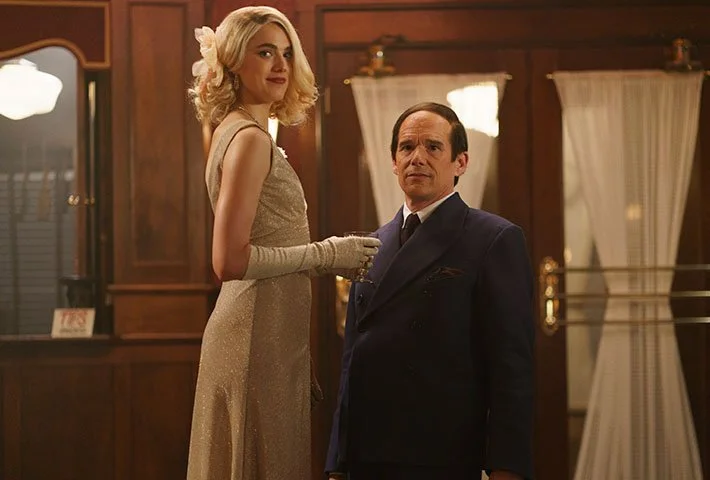
As he drinks and rambles, the bar seems to envelope him. Linklater and cinematographer Shane Kelly explore nearly every angle of Sardi’s. However, where that setting can work beautifully on stage as a set piece, on film Blue Moon feels stagnant and at times we feel stuck, though compelled, to stay in a place we might otherwise prefer to leave before the party wraps up.
Scott’s arrival as Rodgers shifts the tone considerably and his performance brings a quiet dignity that counteracts Hart’s volatile nature. There is palpable tension between them, but also admiration and respect. Together, they create great chemistry reminiscing on the whimsical nature of what once was versus the uncertain future of what may come.
Cannavale brings kindness and patience as the trusted barkeep. Qualley’s (not so) innocent young starlet offers another nice boost to a film that seems to need a few jolts of energy to stay engaging.
For all the value in watching these performances, and Hawke’s rhythmic delivery of his lines, the film’s limitations stunt the overall enjoyment. I found myself wishing we had a little less chatter and more absorption into 1940s Manhattan. Let us experience more of Rodgers and Hart’s world - the theaters, the bars, and late night clubs and dives that defined this era’s social scene, context which would prove quite helpful.
While Blue Moon is not exactly Linklater’s most accessible work or even his most ambitious, in its own way, the film is among his most intimate. Hart’s fragile ego is captured expertly by Hawke’s intense and unrelenting urgency. While the film may be too “talky” or move too slow for some, others will find the rhythms, melodies, and refrains it creates as thoughtful, moving and appropriately melancholy.
CAST & CREW
Starring: Ethan Hawke, Andrew Scott, Margaret Qualley, Bobby Cannavale, Jonah Lees, Patrick Kennedy, Simon Delaney, Cillian Sullivan
Director: Richard Linklater
Written by: Robert Kaplow
Release Date: October 17, 2025
Sony Pictures Classics