
Exit 8 (2026)

SHOULD I SEE IT?
YES
Video game adaptation Exit 8 is a clever, immersive, cinematic “escape room” viewing experience. Fans of the game will likely love this.
The notion of having to identify anomalies to move on in the story is compelling and brings a gamesmanship and intensity to the storytelling and atmosphere.
Genki Kawamura has taken a minimalist walking video game and found context and meaning behind how The Lost Man and a couple other characters find themselves stuck in an infinite time loop.
NO
As perhaps expected, Exit 8 can feel a bit repetitive, even at 95 minutes in length.
The film is plenty intense, but the attempt to frighten with a series of jump scares falls flat and misses the mark.
Mileage may vary on how people connect the concept to the emotional beats found in the screenplay. For some, this may hit way too squarely on the nose.
OUR REVIEW
Adapting video games for the big screen has rarely been a recipe for success, but that doesn’t stop studios from trying to draw popular video games into cinematic adaptations.
Enter Japan’s Exit 8 - adapted from “The Exit 8,” a minimalist walking game by Kotake Create. The appeal, beyond being relatively simple and accessible to play, comes from the growing interest in liminal space movies and media. For those unfamiliar with the growing popularity of this genre, Google or Wikipedia the term “backrooms” and get up to speed.
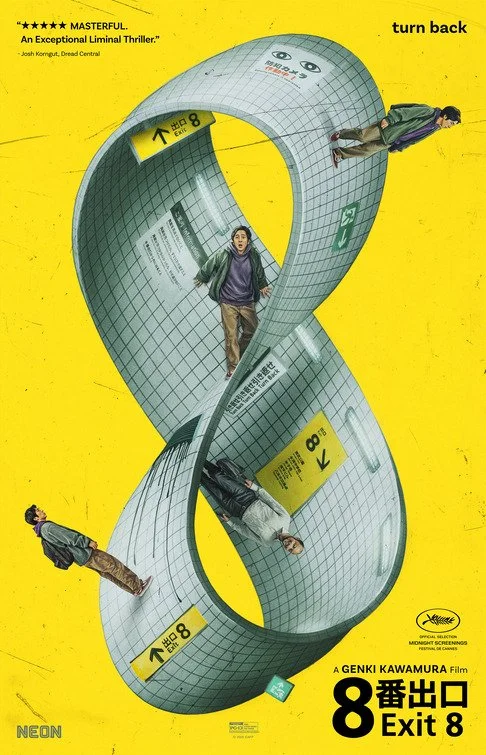
Exit 8 is an interesting film because it literally takes a game where you walk along in a game design akin to a Möbius strip and have to work your way through discovering hints or anomalies to advance to the next level. In fact, the rules of Exit 8 are made very clear, in a sign on the wall of the unending hallway that our protagonist finds himself stuck within.
Rule 1: Don’t overlook any anomalies
Rule 2: If you find anomalies, turn back immediately
Rule 3: If you don’t find anomalies, do not turn back
Rule 4: Proceed to go out to Exit 8
That is, unless you are the one stuck in the never-ending loop that The Lost Man (Kazunari Ninomiya) finds himself in. On his way to a temporary job after a stressful subway ride where he observes a businessman berating a mother and her crying baby for being too loud, our protagonist gets a phone call from his ex-girlfriend (Nana Komatsu) that gives him pause. A bit numb to everything, he heads up the stairs, bypasses a man walking with a briefcase and a cell phone, turns left, then right …
And ends up right back where he just was - with the previous man walking past him in exactly the same manner. After this occurs a few times, The Lost Man realizes things are not quite right. He finds a sign on the wall with the rules. He takes stock in everything he sees. He tries talking to The Walking Man (Yamato Kôchi) to no avail.
Every time he violates a rule, his Exit sign reads 0. Each time he succeeds, the number increases by one. To reach Exit 8, he must discover and overcome a series of puzzles, anomalies, and dangerous situations. One misstep and everything resets itself back to Exit 0.
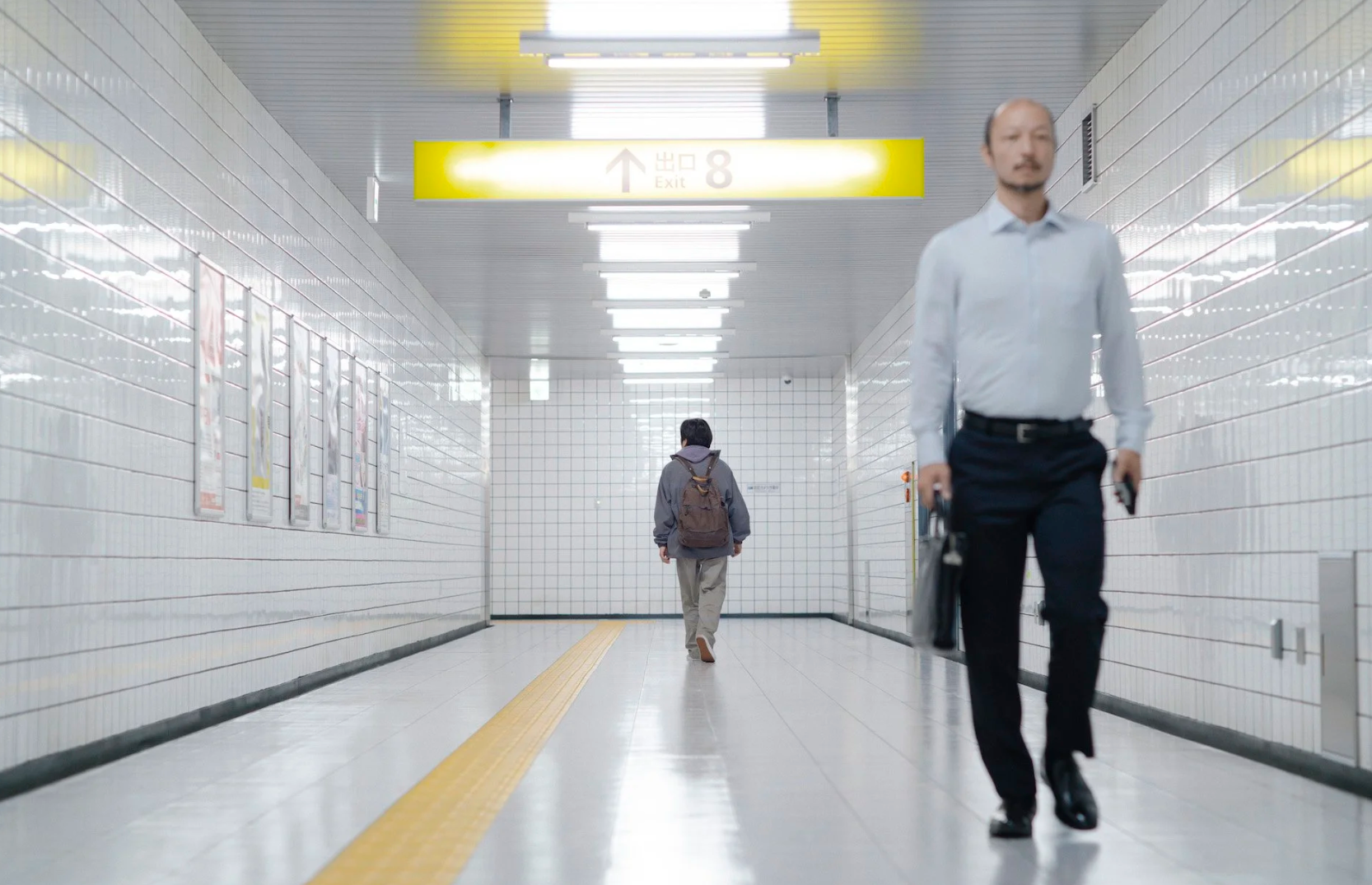
As a second feature for director Genki Kawamura, the film runs the risk of cycling back onto itself a few too man times. However, through some precise direction and flawless editing, Exit 8 becomes an immersive cinematic escape room. Not without its dangers and mysteries, the film proves tense and unsettling at times as we simply do not know what anomaly will next present itself for The Lost Man.
The need to focus on details may be greater and more intense within the video game, but there’s a gamesmanship happening on screen as well. Kawamura draws us in to The Lost Man’s nightmare situation and we are scouring everything on screen, reciting along with The Lost Man everything he sees as he searches for an anomaly.
Unlike the game, we get some context and back stories here which also help flesh out a rather simple premise and rather limited treatment for a feature film. Kawamura, who wrote the screenplay with Kentaro Hirase, shows us how The Walking Man became a part of the subway tunnel, the significance of a little boy (Naru Asanuma) and his arrival in the loop, and context around why The Lost Man is truly lost, in more ways than one.
At times, the repetitive nature of the story can overwhelm things and its one major jump scare attempt misses the mark. But Exit 8 is more about unlocking a destination - it serves as a metaphor for feeling stuck in life, searching for meaning, and trying to walk through things again and again wondering how you can make something better. Kawamura taps into an uneasiness we can all relate to. In The Lost Man, we have a character who has to figure out how to get out of his immediate situation, while also disrupting comfort of his own life and take responsibility and ownership for his decisions.
Exit 8 is not your garden variety video game adaptation. Kawamura has found symbolism and purpose in The Lost Man’s plight. Come for the endless loop, stay for the existential crisis playing out in real time.
CAST & CREW
Starring: Kazunari Ninomiya, Yamato Kôchi, Naru Asanuma, Kotone Hanase, Nana Komatsu
Director: Genki Kawamura
Written by: Genki Kawamura, Kentaro Hirase
Adapted from the video game “The Exit 8” by Kotake Create
Release Date: April 10, 2026
NEON