
Musk (2026)

SHOULD I SEE IT?
YES
Oscar winning filmmaker Alex Gibney meticulously crafts a fascinating, deeply unsettling account of Elon Musk’s rise and extraordinary influence.
Archival footage and personal interviews present a situation where there may be consequences of Musk’s seemingly unchecked power.
Despite its nearly four-hour runtime, the documentary remains engaging, with a particularly jaw-dropping second half.
NO
Gibney documents Musk’s contradictions more successfully than he explains the motivations behind them. He never quite cracks the code.
The decision to feature a simulated AI/CGI version of Musk becomes a distracting framing device that interrupts Gibney’s investigative flow.
For those familiar with the exhaustive book on Musk, written by Walter Isaacson, even at nearly four hours you may feel Gibney rushing through certain things, leaving one to wonder whether a multipart series would have been better.
OUR REVIEW
Elon Musk may not be someone you think about all that often, but he probably has left an impression on your everyday life. Perhaps his company Tesla created the car you or a neighbor drives. Or maybe you live in a location that relies on Starlink to provide you access to the internet. You might use Grok as your chosen AI tool or live in a community where a SpaceX office employs hundreds of local residents.
He might own your preferred social media platform, X, formerly known as Twitter. You may read his rhetoric and opinions there and see them go viral and dominate a news cycle. Perhaps he has contributed hundreds of millions of dollars to political action committees and endorses candidates and causes you support or reject, as he attempts to use his influence on our elections. You might have seen him make provocative comments or controversial gestures during campaign rallies. Then, you may also know that he led the Trump Administration’s Department of Government Efficiency (DOGE), which gutted the very institutions that many people value, cost thousands of people their jobs and detrimentally impacted the lives of vulnerable people around the world by cutting funding to countries that rely on U.S. donations of food, clothing, and other necessities to fight poverty.
When looking at everywhere Musk is and everything he touches, the man’s influence is staggering. He has become so deeply enmeshed in our day-to-day lives that the United States government would face significant security challenges in unwinding partnerships with his companies. Sure, you can ignore the news he makes. But avoiding his reach is considerably more difficult.
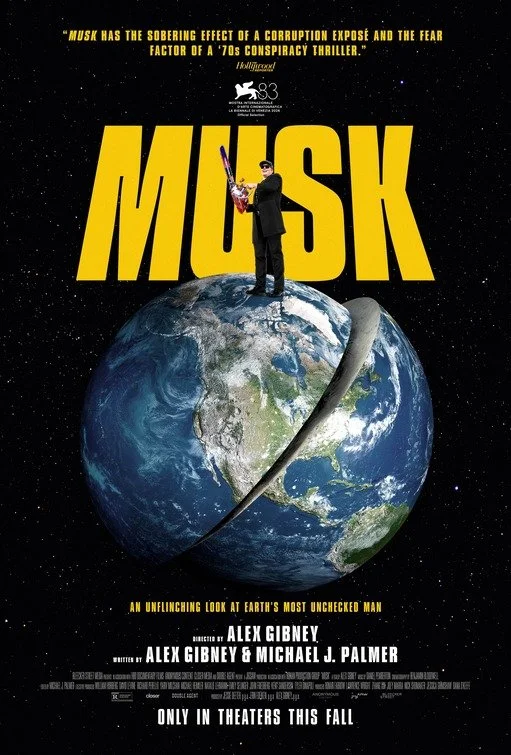
To truly capture who Elon Musk is, and help people better understand the man who envisions himself as a real-life Tony Stark/Iron Man, Oscar-winning documentarian Alex Gibney takes a noble crack at it. He has crafted a sprawling, informative, exhaustive, nearly four-hour documentary, Musk, tracing Musk’s improbable rise. An investigative filmmaker with a journalist’s background, Gibney constructs an often fascinating account of a visionary whose wealth and ambitions have given him extraordinary power.
By the end of Gibney’s film, the scope of Musk’s power is, in a word, frightening. However, as Gibney heightens anxieties from one scene to the next, he falls somewhat short at what may be an impossible task: providing “the why” behind Musk’s desperate need for attention and his insatiable drive to create, develop, and disrupt the world we all live in.
Before Gibney even finished the film, Musk took to his X account and called the project “a hit piece.” His elusiveness and refusal to participate in the film are addressed straightaway. Gibney turned to a trove of archival material - interviews, videos, speeches and presentations - while also interviewing people who got to know him on a deeply personal level; among them, his first wife and mother of six of his children, Justine Musk, and conservative influencer Ashley St. Clair, who gave birth to one of Musk’s children in 2024.
Musk appears in the film in a cheeky, somewhat goofy manner. Drawing on Musk’s often discussed belief that we may be living in a simulation, we see a digital representation of Elon Musk walk into a video game-style environment and sit in a chair and begin talking. By curating a database full of countless hours of Musk’s own verbal responses and quotes through the last 30 or so years, Gibney gives us an AI/CGI hybrid-representation of Musk, speaking and addressing certain topics as they come up in the narrative.
Conceptually, this strangely makes sense. A man who imagines himself living inside a constructed reality becomes a construction within someone else’s examination of his life. What initially looks and sounds pretty clever ends up hampering the film’s overall effectiveness, as it disrupts the cadence and flow of Gibney’s thesis. Voiceover and still images would have worked better because an artificial Musk feels almost silly for a film with such grandiose goals and objectives.
Viewers familiar with Musk’s childhood in apartheid-era South Africa, his emigration to Canada, and his early business ventures may find relatively little groundbreaking information here. For a large portion of the film’s first half, Gibney examines the controversies around Musk’s reputation as a singular inventor and the more complicated history of the companies associated with his name. What some will see as genius-level brilliance and unimpeachable business acumen, others may see Musk’s actions in generating his wealth as cunning, backstabbing, and ruthless. His ability to recognize possibilities, attract talent, and expand businesses is significant. But so are the contributions of the people whose work disappears beneath the mythology of the man at the top.

Following a 10-minute intermission, Musk turns from intense and uncomfortable to jaw-dropping and disturbing. He abandons his transgender daughter Vivian, attacks her in posts on X, and refuses his ex-wife’s pleas for him to stay in her life. He acquires Twitter and transforms it into X. By September 2024, Musk and his fellow investors had reportedly suffered approximately $24 billion in losses on the acquisition. Gibney attempts to determine when and where Musk embraced Donald Trump, and points to Musk’s actions during COVID. As the pandemic was killing thousands and people were trying to catch up to the horrors happening around them, Musk spread a number of false and dangerous comments on Twitter, only to then reopen a Tesla manufacturing plant in Fremont, California, defying lockdown orders. More than 400 Tesla employees subsequently tested positive.
Gibney’s approach builds this story effectively, layer by layer, and he is a masterful researcher. Though his narration can sometimes get in the way, here he frequently steps back, allowing archival footage and interviews to keep things moving forward.
I admit I was rarely bored. But one has to wonder whether a multipart series would have given this material more room to breathe and expand. Even at this length, Gibney rushes through Musk’s story and leaves us asking a fair number of unanswered questions as the film steamrolls forward.
One consistent thing you notice is how Musk may have a grand vision and give ample opportunities for people to jump in and make a difference with his work. But it is his treatment of those he lets get close - President Trump, ex-wives and mothers of his children, former business partners, etc. - which proves jaw-dropping.
A recurring question is why Musk lies and exaggerates. Scientists and experts challenge the feasibility of his plans for eventually settling on Mars. Gibney presents damning evidence that Tesla’s driver-assistance capabilities were grossly misrepresented. He has amplified stolen election claims from 2020 on X that have never been proven, supported antisemitic posts, and reposted and shared a wide array of misinformation on a variety of subjects.
Gibney’s dismantling of DOGE should give everyone pause. Musk initially claimed the initiative could eliminate $2 trillion in federal spending. DOGE later reported $215 billion in savings, but a Government Accountability Office review found insufficient information to verify approximately 96% of its claimed savings from terminated grants. With thousands of people losing jobs and crucial government programs slashed, the gap between promised efficiency and documented results is devastating.
The film serves as a wake-up call about the unfettered power one person has accumulated and the institutions that have allowed it to grow. Gibney makes the consequences frighteningly clear. What remains less clear is what drives the man whose contradictions take four hours to document. Perhaps expecting Gibney to find a definitive answer to that question is asking too much, particularly when the subject denies participation. Still, the question remains.
Musk left me fascinated, angry, and unsettled about the reach of Elon Musk’s influence. And though it’s a Herculean effort on the filmmaker’s part, I wish Gibney had helped us all get a little closer to understanding the inner workings of a person who thinks he lives inside a simulation.
CAST & CREW
Starring: Elon Musk, Justine Musk, Ashley St. Clair, Kara Swisher, Zoë Schiffer, Martin Eberhard, Geoffrey Hinton, Sam Harris, Errol Musk
Director: Alex Gibney
Written by: Alex Gibney, Michael J. Palmer
Release Date: October 9, 2026
Bleecker Street Media