
The Social Reckoning (2026)

SHOULD I SEE IT?
YES
Mikey Madison and Jeremy Allen White deliver strong performances, giving The Social Reckoning storyline some much-needed credibility and urgency.
Fans of Aaron Sorkin's trademark writing style will find moments of engagement, even when the material feels somewhat familiar and obvious.
Sorkin ponders consequential questions about social media accountability, misinformation, and the enormous influence of Meta's platforms…
NO
…However, his outrage feels years too late and rarely translates into the sweeping revelations and discoveries he thinks he is bringing to the screen.
As a fan of Jeremy Strong’s acting, his performance as Mark Zuckerberg feels off-key - oddly robotic and disconnected from what Jesse Eisenberg created in The Social Network.
Sorkin’s uninspired direction and convenient outrage amount to little more than finger-wagging and scolding, rather than the meaningful reckoning the film’s title promises.
OUR REVIEW
At the end of the 2010 film The Social Network, Facebook founder Mark Zuckerberg repeatedly refreshes his screen, hoping that a friend request sent to his ex-girlfriend will be accepted. This moment, written by Aaron Sorkin and directed by David Fincher, was the perfect way to illustrate just how deeply connected we all want to be to someone or something. In this moment, we also bear witness to how social media can draw people in to the point of obsession. That longing for a response, the impulsive refreshing of a screen again and again, and the desire to be “accepted” foretold the temperament of what society would become in the ensuing decade.
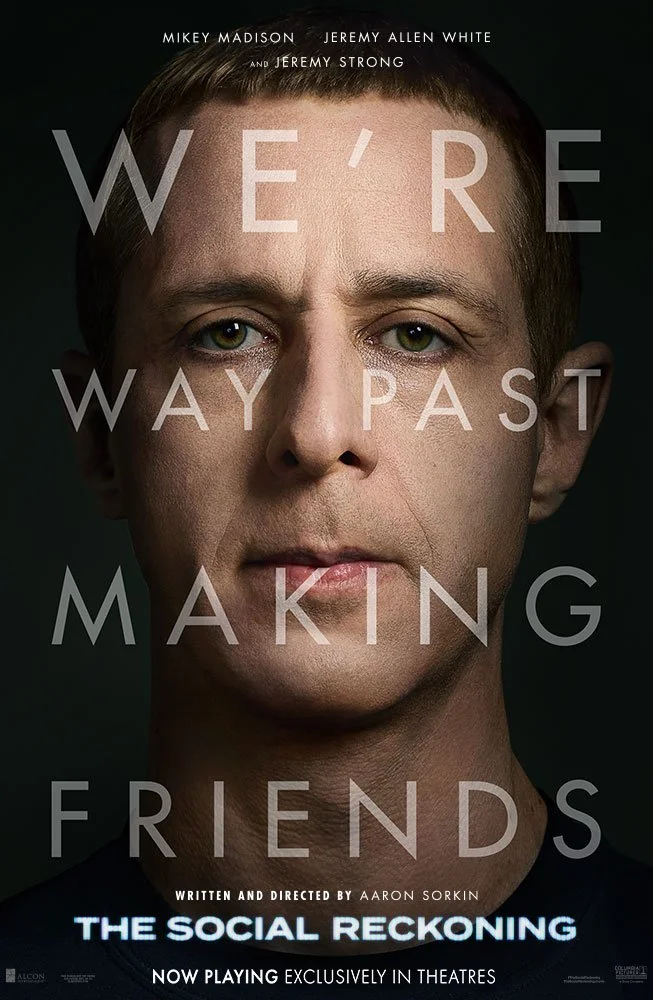
Where Jesse Eisenberg played Zuckerberg in 2010, method actor Jeremy Strong portrays him in 2026’s The Social Reckoning, a quasi-sequel, quasi-adjacent film to the Fincher original. Sorkin writes and directs this time around, and the result is a lackluster attempt to provoke anger and frustration. While Sorkin’s investigative drama envisions itself as a social media version of All the President’s Men or Spotlight, exposing Facebook’s malfeasance and reckless disregard for ethical practices, he misses the mark. He takes some bold swings, but despite a handful of effective performances, Sorkin never finds a molten hot core to his outrage.
Frankly, we simply know and have seen too much of the world into which The Social Reckoning arrives. Pointing fingers and yelling, “Be mad, people!” for two hours doesn’t come as easily as it once did, I suppose.
On the surface, Sorkin’s film looks the part well enough. Pacing isn’t necessarily the issue, although the film occasionally gets bogged down by Sorkin’s trademark textbook-volume of dialogue. As it turns out, a lot has happened since Zuckerberg launched Facebook. What once consisted of users creating accounts, posting food and family pictures, and sharing witty little asides evolved into an almost limitless assortment of groups catering to every imaginable interest. Marketplace allowed people to buy, sell, and trade, while companies and news outlets gravitated to the platform to share news, information, videos, and updates.
Before long, Facebook became a tool in the political strategist’s toolbox. Live video allowed users to capture events in real time, as they happened. Facebook was no longer simply a virtual town square where people chit-chatted and commented as “friends.” It became a place where people could post and share increasingly outrageous content. With inadequate moderation, conspiracy theories, false stories, fabricated information, dangerous allegations, and unsettling videos found their way into people’s algorithms.
Of course, we all know this because we live it every day. We may condemn Facebook, then toggle over to Instagram because we enjoy sharing pictures. Maybe we will watch some Reels while we’re at it, then open WhatsApp to send someone a message. The reality is that Meta owns all those platforms and we are ensnared in its digital ecosystem. For Zuckerberg, that does kind of beat clicking refresh and hoping one person accepts your friend request. In June 2026, Meta averaged approximately 3.6 billion daily active people across its applications.
That data point matters because the crux of Sorkin’s argument, and that of many social media detractors, is that Zuckerberg’s influence on the world has carried enormous consequences. The Social Reckoning examines that influence through whistleblower Frances Haugen (Mikey Madison) and her decision to share internal Facebook documents and information with The Wall Street Journal reporter Jeff Horwitz (Jeremy Allen White). Haugen discovers evidence of how Facebook ignored hate speech and extremism, failed to address shortcomings in its age-verification tools, and promoted platforms, particularly Instagram, to children despite concerns about the effects on youth mental health and well-being.
Horwitz, assigned the story by a San Francisco bureau chief (Betty Gilpin), is not especially tech-savvy, but he knows how to investigate a story. And eventually, he crosses paths with Haugen when she decides to share her confidential findings.

Sorkin initially lulls us into believing his film will deliver a wealth of surprising details and shocking revelations. Despite his flattened color palette and largely unimaginative directorial choices, the almost staccato rhythm of his dialogue keeps us listening and engaged. Madison is terrific, while White is convincing as the dig-deep-then-deeper type of investigative journalist.
However, as Sorkin pushes us along, we begin realizing that much of this information is already familiar. The revelations rarely feel jaw-dropping or groundbreaking, not because they lack significance, but because we have been living with these consequences for years. Now, with AI-generated content appearing constantly and relatively few meaningful safeguards in place, Facebook increasingly resembles a cesspool of fabricated stories, inauthentic images, and questionable information. The problems Sorkin wants us to become upset about have simply become part of our every day digital experience. His criticism feels quite late to the cultural conversation we have been having for quite a long time.
Strong, meanwhile, is largely confined to a subplot involving Zuckerberg’s preparation for a 2021 Congressional appearance. His coach (Wunmi Mosaku) is frequently interrupted by, and often defers to, team strategist and former Facebook employee Charlie Garrigan (Bill Burr). They argue, they bicker, and Zuckerberg steadfastly refuses to stifle a Facebook user’s “free speech.”
But under Sorkin’s direction, Strong reduces Zuckerberg to an almost vacant, robotic personality. Where Eisenberg had opportunities to reveal a range of emotions and reactions, Strong seems to embody a caricature of a man who bears little resemblance to reality. Meanwhile, Alexandre Desplat’s ultra-symphonic score seems determined to remind us just how important certain scenes and moments are.
And therein lies the film’s biggest problem. Sorkin is so intent on telling us how outrageous these revelations are, he rarely finds a compelling way to make us experience that outrage ourselves.
The Social Reckoning attempts to frame its story around quiet people who try to speak up but are drowned out by louder, brasher, more arrogant voices. Sorkin is clearly angry, frustrated that society willingly places such blind trust in platforms offering inadequate protections and accountability.
But what are we supposed to do about it, exactly? What is Sorkin’s call to action?
For a movie so determined to hold Facebook, Meta, and Mark Zuckerberg accountable, The Social Reckoning seems unwilling or unable to offer much of a reckoning after all.
CAST & CREW
Starring: Mikey Madison, Jeremy Allen White, Jeremy Strong, Bill Burr, Wunmi Mosaku, Billy Magnussen, Betty Gilpin, Gbenga Akinnagbe, Anna Lambe, Portia Doubleday, Patrick Fischler, Michael Braugher, Sierra Capri, Nelson Franklin
Director: Aaron Sorkin
Written by: Aaron Sorkin
Release Date: October 9,, 2026
Sony Pictures Releasing