
You Can See Everything (2026)

SHOULD I SEE IT?
YES
One of the best films and documentaries of 2026, but also one of the best films and documentaries of the decade. Know as little as possible going in.
Nathan Fielder and Lance Oppenheim turn extraordinary access into an unpredictable, hilarious, and deeply unsettling examination of trust and manipulation.
Through superb editing and storytelling, You Can See Everything challenges our perceptions repeatedly, leaving us questioning both the people onscreen and our own judgment and reaction to what we are witnessing.
NO
If you are not a fan of Nathan Fielder’s style and approach, this will be a long sit for you.
Fielder’s deliberately uncomfortable approach and the film’s sustained ambiguity may try people’s patience.
How you react to the film’s twists and turns and reveals will say a lot about how you perceive this one-of-a-kind film and viewing experience.
OUR REVIEW
Nathan Fielder has made a career out of making people uncomfortable, including those watching his unique, and, at times, bizarre televised comedic experimentation. In Nathan for You, he offered businesses elaborate and often absurd solutions to the problems they were having. In The Rehearsal, he designed and recreated real-life situations to help people prepare for difficult conversations or experiences they needed to face. Blending a provocateur’s smirk with a rapier wit, Fielder has always danced on the precipice of leaving viewers wondering where his sincerity ends and his performance becomes the focal point.
His deadpan, low affect delivery rivals that of famous comedian Steven Wright, but Fielder has a masterful way of creating original, unbearable, cringe-inducing moments that leave us in awe. His genuine curiosity and inner desire to entertain create a world where we can’t tell whether the entertainment becomes manipulation or the manipulation becomes entertainment.
Now, take that approach and put him in a room with Elizabeth Holmes for 34 days.
In You Can See Everything, co-directed by Fielder and Lance Oppenheim (Primetime), he is invited to stay with Holmes and her partner Billy Evans, and their two young children, in a San Diego beachfront home in the days leading up to her being incarcerated at a minimum-security prison in Bryan, Texas. Beginning in the weeks before her incarceration, and documenting the years that follow, the idea is for audiences to meet the real Elizabeth.
Remove the headlines, the courtroom coverage, ignore her share of a $452 million restitution order, and see her for who she truly is … a doting mother and dedicated and kind-hearted individual who truly believes she has created something good, beneficial, and life-changing.
As a reminder, Holmes was convicted of defrauding investors through her blood-testing company, Theranos. Theranos was built on the promise of a device that could run a wide array of blood tests quickly and accurately from a single pinprick of blood. In 2015, just one year after Theranos was valued at $9 billion, the Wall Street Journal reported that the technology simply did not work. The company, unable to deliver on its promises, crumbled in 2018 and Holmes was convicted of federal wire fraud and began serving an 11-year, three-month prison sentence in 2023.
The whole concept of this particular film is bonkers from set-up to execution, but Fielder and his crew film Holmes and Evans daily in their home. Shockingly, he learns that plans are in place to essentially resurrect Theranos 2.0, as calls to potential investors and media come fast and furious. Fielder, hilariously, is shown lurking in the background at first with equipment in hand, recording conversations and interactions happening in front of him. At times, he looks like an interloper who doesn’t belong. However, soon, he starts asking questions and worms his way into the daily cadence of Holmes and Evans’ lives.
His questions are sudden, probing, and impulsive. Holmes maintains innocence, believing that she has done nothing wrong. Evans fully agrees. During an extended sequence, Holmes walks through the design components of the Edison, the Theranos device that reportedly can run the testing. In their conversation, Fielder discovers that Holmes’ statement that the machine can run the test is inaccurate because Holmes likewise concedes that the proper chemistries were not in place for testing to be successful. Fielder presses her that the machine therefore cannot do what it says and she doesn’t understand. “But it can run the test,” she insists - wide-eyed, smiling, in an almost reassuring manner.
To talk much more about You Can See Everything does it a disservice because every single time you think you have figured things out, the film pulls another rug out from under you. The access Fielder gets is fascinating and strange. But why, and why him? Holmes admits she is unfamiliar with his work but Billy is a fan. Is that true? Why would either of them choose a known deconstructionist and occasionally an unreliable narrator to help rehabilitate a severely destroyed public image?

Fielder and Oppenheim are so skilled at storytelling that each unanswered question propels the film forward. The tremendous precision that editor Adam Locke-Norton utilizes in keeping all these developments clear and concise is among the finest feats of editing in recent memory. Everything begins to feel significant: Billy taking over the beating of eggs in a bowl. Billy’s agitation with Fielder’s questions. The guarded, almost whispery conversations Fielder has with Holmes’ parents. And then, somewhat unexpectedly, the friendship that develops between Fielder and Holmes.
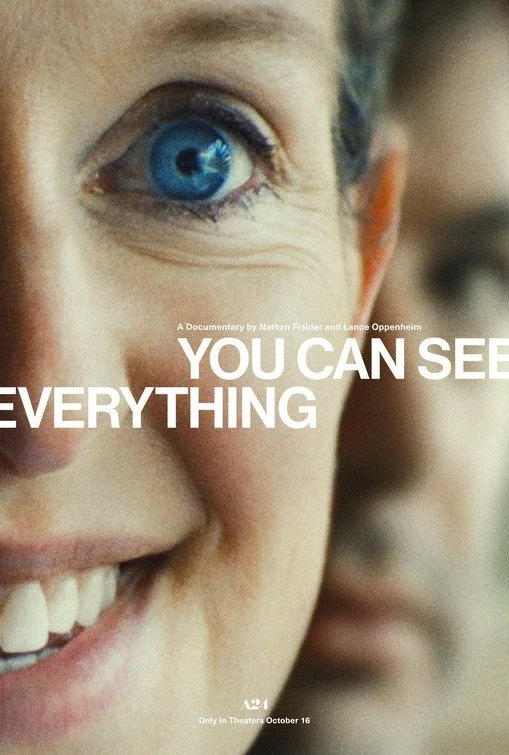
Does he see her as misunderstood, manipulated, or misguided? Has the master manipulator met his match? Holmes presents herself as someone who simply wants to make people happy. Her even-keeled demeanor is convincing. However, she also talks about never wanting to be in the spotlight and struggling with media attention, never wanting to be the person who cried in front of the cameras. Yet, by my count, tears fall from her face at least a half dozen times over the course of the film and, naturally, cinematographer David Bolen’s close-ups capture every tear that forms in Holmes’ expressive blue eyes. Plus, cameras are everywhere, 24/7, in those final two weeks before she reports to prison.
Scenes are often funny, even hilarious, and bordering on outrageous. But then the film resets itself to a bewildering mental chess match that proves unnerving. Sure, there’s absurdity, but there’s genuineness at play here. What are we laughing at? Is Holmes playing Fielder? Is Fielder playing Holmes? Is she evading accountability or are we simply misunderstanding her?
Steeped in contradictions, the ride is breathtaking. There’s also a cruelty lingering just under the surface. As Evans fights for more and more control over the filmmaking process, is it necessary to have Holmes watch The Dropout, the Hulu limited series in which Amanda Seyfried won an Emmy portraying her? The layers of all of this are impossible to cut through and the surrealism of Holmes watching Seyfried play her in a television show is Fielder at arguably his most daring and bold.
And that is about half the movie. When Fielder brings in an unexpected collaborator, the film becomes something entirely different. Holmes’ incarceration changes the relationships we have been watching and Fielder’s attempts to understand these people clearer raises uncomfortable questions about his own role in the story.
By the end, when Fielder tries to rationalize everything he has experienced with his colleague, everything has blurred together. The filmmaking is extraordinary. Scenes build through pauses, interruptions, glances, and detours that challenge our understanding of what came before. A fireside conversation in the final act could be condensed, but the film rarely loosens its grip on us as observers.
You Can See Everything takes enormous risks because it trusts its audience. If Nathan Fielder is not someone you can spend three hours with, this will feel exhausting. Others may not appreciate how it plays with emotions, perceptions, and belief. I was riveted. My heart was beating in my chest. I constantly re-evaluated everything I was watching.
This may be the best film of the year, and one of the best of the decade. I will be thinking about this movie for years to come.
Leaving us to wonder - did we see everything? Honestly, I am still trying to understand what I saw. And it would not surprise me at all if we were the experiment the entire time.
CAST & CREW
Starring: Elizabeth Holmes, Nathan Fielder, Billy Evans, Amanda Seyfried, Christopher Abbott
Director: Nathan Fielder, Lance Oppenheim
Release Date: October 16, 2026
A24